Apparel is classified by how a garment is built, not what it is called. The four questions customs applies in order - knit versus woven, principal fibre, gender and age, and special features - for UK and US import.
Clothing is among the most commonly imported product categories, and among the most frequently misclassified. The reason is that a garment's tariff code is not decided by what it is called but by how it is built, and the same-looking item can sit in a different chapter, at a different duty rate, depending on details a marketing description never mentions. This guide walks through the decisions a correct apparel classification actually turns on, in the order customs applies them, for both UK and US import.
The short version
To classify a garment you work through four questions in order: is it knitted or woven, what is its principal fibre, who is it for (men, women, boys, girls or babies), and does any special feature change the answer. The first question decides the chapter, and the rest narrow the code down to the full ten digits used by the UK commodity code and the US HTSUS. Get the first question wrong and everything after it is wrong too.
Question one: knitted or woven
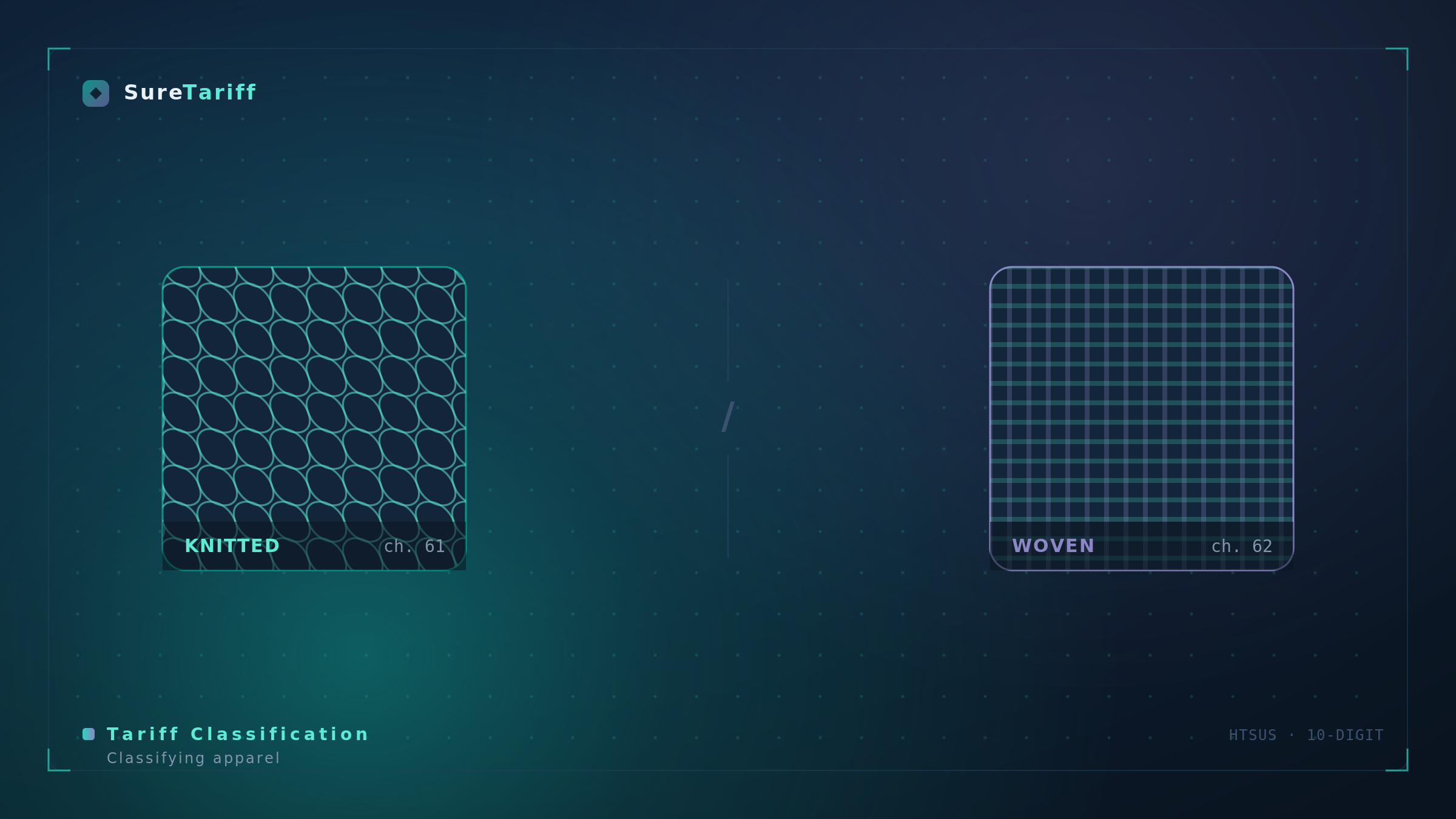
This is the fork that decides everything else. Chapter 61 covers garments that are knitted or crocheted. Chapter 62 covers garments that are woven, that is, not knitted or crocheted. The distinction is about how the fabric is constructed, not how the finished garment looks. A knitted shirt and a woven shirt can look almost identical on a rail and still belong in different chapters, with different duty rates and different rules of origin.
Knitted fabrics are formed from yarn in interlocking loops, which is what gives them their stretch: jersey, rib, interlock, piqué. T-shirts, sweatshirts, hoodies and most polo shirts are usually chapter 61. Woven fabrics are made from interlaced warp and weft threads: denim, twill, poplin, flannel. Dress shirts, woven trousers and many jackets are usually chapter 62. Because this single decision drives the whole classification, it is the first thing to establish and the most expensive thing to get wrong.
Mixed-construction garments are where it gets harder. A jacket with a knitted body and woven sleeves cannot be classified by looking at one component. Here the interpretation rules step in, and the garment is classified by the material that gives it its essential character, which requires a judgement about which component defines the garment rather than a simple look-up.
Question two: the principal fibre
Within a chapter, headings and subheadings split by fibre. Cotton, wool, man-made fibres and other materials fall under different codes, and the fibre can change the duty rate and the rules of origin.
The rule that catches people is the 85 per cent threshold. Where a single fibre makes up 85 per cent or more of the garment by weight, that fibre generally drives the subheading. Where no single fibre reaches 85 per cent, the garment is a blend, and separate rules decide which fibre governs. This is why fibre content by weight, not just the headline material on the label, is a data point you need for every style, and why "cotton-rich" or "mostly polyester" is not precise enough to classify against.
Question three: who the garment is for
Gender and age are structural parts of the code, not optional metadata. Men's and boys' garments occupy different subheadings from women's and girls', even for a physically similar item, and babies' garments have their own headings again.
The gender test is more specific than most people expect. A garment closing left over right at the front is treated as men's or boys'; right over left is treated as women's or girls'. That rule applies unless the cut of the garment clearly indicates one sex, in which case the cut wins. Where a garment genuinely cannot be assigned to either, it defaults to the women's or girls' heading. Customs authorities take gender seriously as a classification criterion, and a mismatch between the declared gender and the garment is a common trigger for a query. Babies' garments, broadly those for infants up to around 86 centimetres in body length, sit in their own headings and should not be swept into the general men's or women's lines.
Question four: special features
Some features override the general answer. Coatings, laminations and certain performance treatments can move a garment to a different code, and technical outerwear is a category of its own. Recreational and performance outerwear can turn on whether it meets a defined set of construction characteristics, for example water resistance, critically sealed seams and a specified number of listed features such as insulation, particular pocket types, tightening mechanisms or venting. A garment that meets the test and one that does not can end up in different places, so for technical product the specification sheet matters as much as the fabric.
Why apparel is where product variation hurts most
Put the four questions together and you can see why a clothing range is so much work to classify. A single style might exist in several fabrics, in men's and women's cuts, in a knitted and a woven version, with and without a performance treatment. Each of those permutations is a separate classification decision, and a brand launches new ones every season. The number of decisions is not the size of the catalogue, it is the size of the catalogue multiplied by its variety, and it renews on the collection calendar.
This is exactly the point at which classifying by hand stops being feasible and starts producing errors, not through carelessness but through sheer volume under time pressure. The same pattern applies to footwear, bags and accessories, categories built on the same kind of proliferation.
Getting it right, and getting certainty
For a genuinely novel or high-value garment, the way to remove doubt is a binding decision from customs: an Advance Tariff Ruling from HMRC in the UK, or a binding ruling from customs in the US, whose published rulings you can search for similar products. Those are worth the effort for the hard cases, though they are slow and specific to the exact garment described.
For the everyday reality of a large, seasonal range, the practical answer is to classify from the product data you already hold, fabric, construction, fibre content, gender and features, at a speed and cost that let you do the whole collection rather than a sample. The same four questions have to be answered again against each market's own schedule, which is what makes entering a second market a full re-classification rather than a translation. A classification service built for apparel understands these forks, and returns each code with a confidence figure and a plain-language explanation of the reasoning: which chapter, why, and on what basis. Where the data is missing the detail that would settle a code, for example whether an item is handmade, it says so, sets out the candidate codes, and tells you what to confirm, rather than committing a guess. That combination, the right code, the reasoning, and an honest flag when a decision is genuinely open, is what makes classifying a whole range at speed something you can actually stand behind.
Interested in learning more? Get in touch to discuss how we can help.
Join a demo