A code spreadsheet is a photograph of the rules on one day. As tariffs and your range change it drifts out of date and holds no audit trail. Why static files fail, and what a live classification service does instead.
Almost every product business starts with a spreadsheet of tariff codes. It is the obvious tool: a column of products, a column of codes, sortable and shareable. The trouble is that a spreadsheet records a decision but not the reasoning behind it, and it captures the tariff as it stood on the day it was filled in. Tariffs do not hold still, and a business does not stand still, so over time the two drift apart and the spreadsheet turns from a convenience into a quiet liability. Here is how that happens, and what to use instead.
The short version
A classification spreadsheet is a photograph of the rules on one day. The rules change, your range changes, and the file does not update itself. It holds codes but not the justification an auditor asks for, it has no idea when a code has gone stale, and a single wrong cell propagates into every costing and every customs entry that draws from it. For a small, static catalogue that is survivable. For a business with a large, changing range it is a risk that grows silently.
How codes go stale
Tariff codes decay from two directions at once.
The international system itself is revised. The World Customs Organization updates the Harmonized System on a roughly five-yearly cycle, and the next revision, known as HS 2027, is already in preparation. When it lands, headings are added, merged and moved, and codes that were correct become obsolete. A spreadsheet filled in under the current edition does not know any of this has happened.
National tariffs change far more often than that, and recently they have changed at a pace few compliance teams have seen before. Across 2025 and into 2026, US tariff measures shifted almost monthly, with reciprocal tariffs, Section 301 actions and expanding Section 232 coverage layering on top of the base rate, so that the effective duty on some goods now stacks well beyond the headline figure. The UK tariff moves too, in step with trade-agreement changes and policy adjustments. A code that was right and a duty rate that was accurate can both be out of date within a season, and a static file gives you no signal that either has moved.
The version-control trap
Ask a practical question of any classification spreadsheet: who entered this code, on what date, against which edition of the tariff, and why? A spreadsheet rarely answers. It holds the code but not the justification, and the justification is exactly what a customs authority wants to see, because enforcement is moving towards audits of your reasoning rather than checks at the border.
Then there is the ordinary chaos of shared files: multiple versions in circulation, edits with no record of who made them or on what basis, a copy someone saved to their desktop six months ago and has been using ever since. Every one of those is a route by which a wrong or outdated code enters your entries without anyone deciding that it should. The spreadsheet was never designed to be a compliance system, and it shows under pressure.
One wrong cell, everywhere
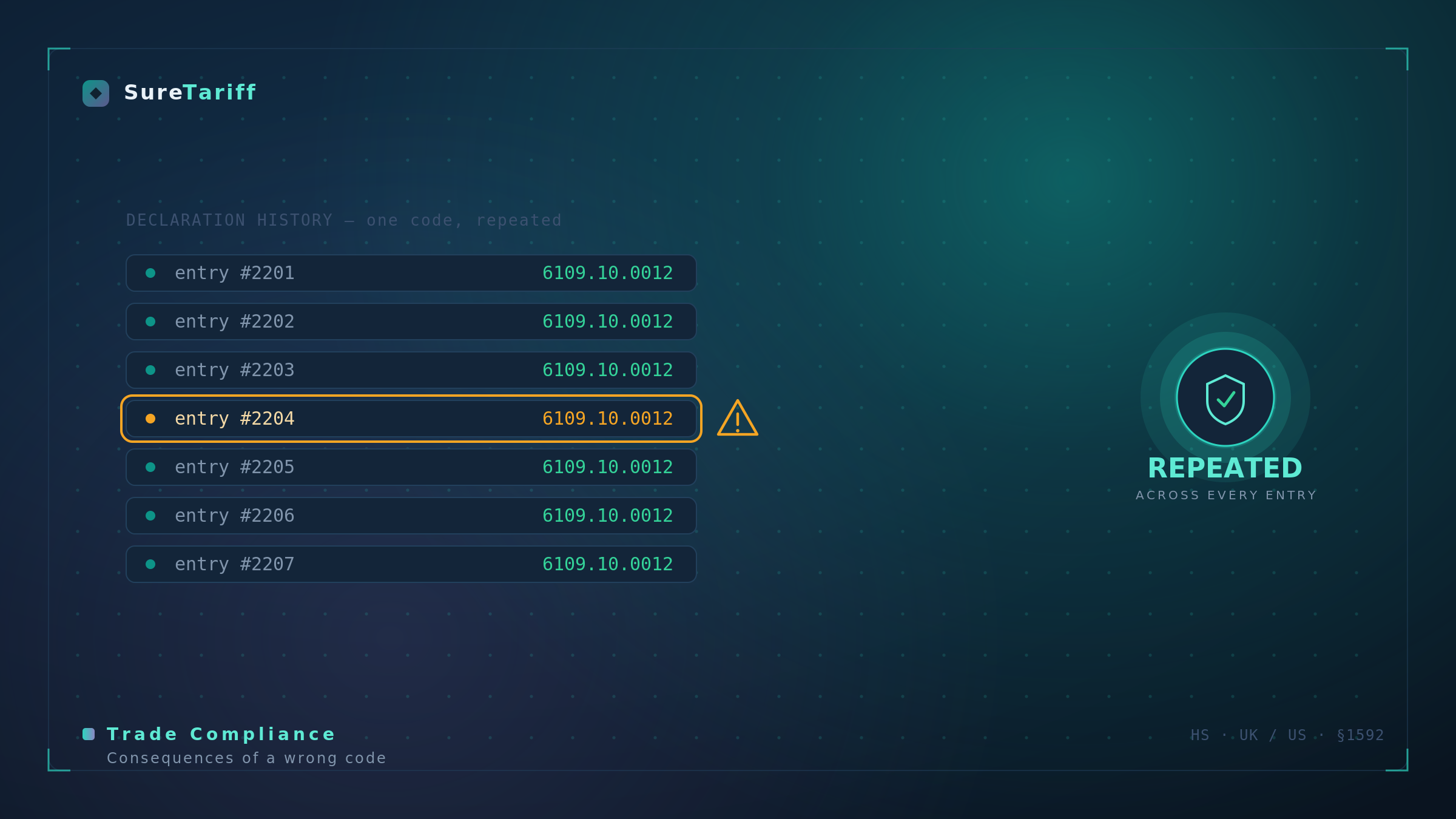
The structural weakness of a spreadsheet is that everything downstream trusts it. A code in one cell flows into landed-cost calculations, into quotes, into your ERP, and onto the customs entry. So a single wrong cell is not a single wrong entry. It is a wrong number repeated across every costing that referenced it and every shipment that used it, for as long as it sits there uncorrected. Because most businesses reuse a product's code on every shipment, that can be a very long time, and the error compounds the whole while. The most damaging version of this is a spreadsheet of home-market codes pressed into service for a new territory, where the national digits were never valid to begin with.
We have watched this play out in real data. A brand importing into both the UK and the US let us run several thousand products from its history back through classification, against the codes it had been using. Where the results disagreed, our classification usually turned out to be the defensible one. None of those discrepancies had announced themselves. They had simply been sitting in the working files, feeding costings and entries, until someone looked. That is the defining feature of spreadsheet risk: it is invisible right up until it is expensive.
What a live service does differently
The alternative is not a better spreadsheet, it is a different model: classify against the current tariff each time, rather than trusting a snapshot. A live classification service works from your existing product data and returns, for each item, the current UK and US code. It does three things a spreadsheet cannot.
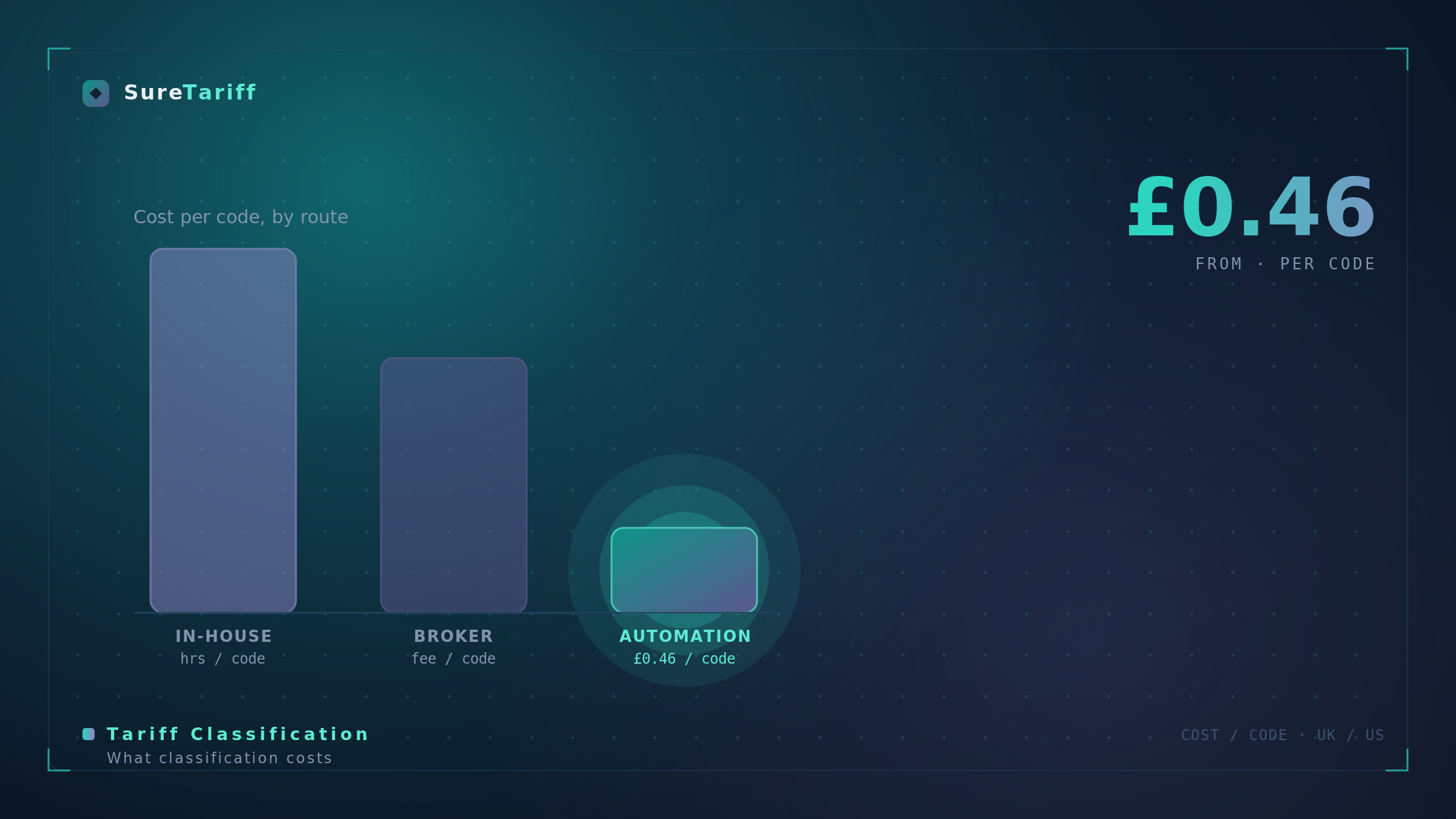
First, it verifies against the tariff as it stands now, so a change in the schedule is reflected rather than silently missed. Second, it returns a confidence figure and a plain-language explanation for each code, which is the audit trail a spreadsheet never held, and where a product is genuinely ambiguous it says so and offers the candidate codes rather than committing a guess to a cell. Third, because re-running the whole range is cheap and quick, you can re-check your catalogue whenever the tariff moves, instead of hoping last year's file still holds.
The practical takeaway
Keep the spreadsheet for what it is good at: a list, a sort, a quick share. Stop asking it to be the thing that keeps you compliant, because that is the one job it is structurally unable to do. A tariff code is only as good as the reasoning behind it and the day it was checked, and those are exactly the two things a static file cannot give you. Classify against the live tariff, keep the reasoning on record, and re-run the range when the rules change. That is the difference between a code you happen to hold and a code you can defend.
Interested in learning more? Get in touch to discuss how we can help.
Join a demo