In-house, broker or automated - what each route to a tariff code really costs, including the hidden cost of getting it wrong, and why per-item cost is the deciding variable for a large, seasonal range.
Most businesses never put a figure on classification, which is part of the problem. The code arrives from a supplier, a broker or an internal spreadsheet, and the cost of getting it is buried in someone's time or a line on an invoice. When you do add it up, across a range that turns over every season, classification is one of the more expensive routine tasks a product business performs, and the largest costs are the ones that never appear on any invoice at all. Here is what each route really costs, and where automation changes the arithmetic.
The three routes, and what each one costs
There are broadly three ways to get a tariff code, and they price very differently.
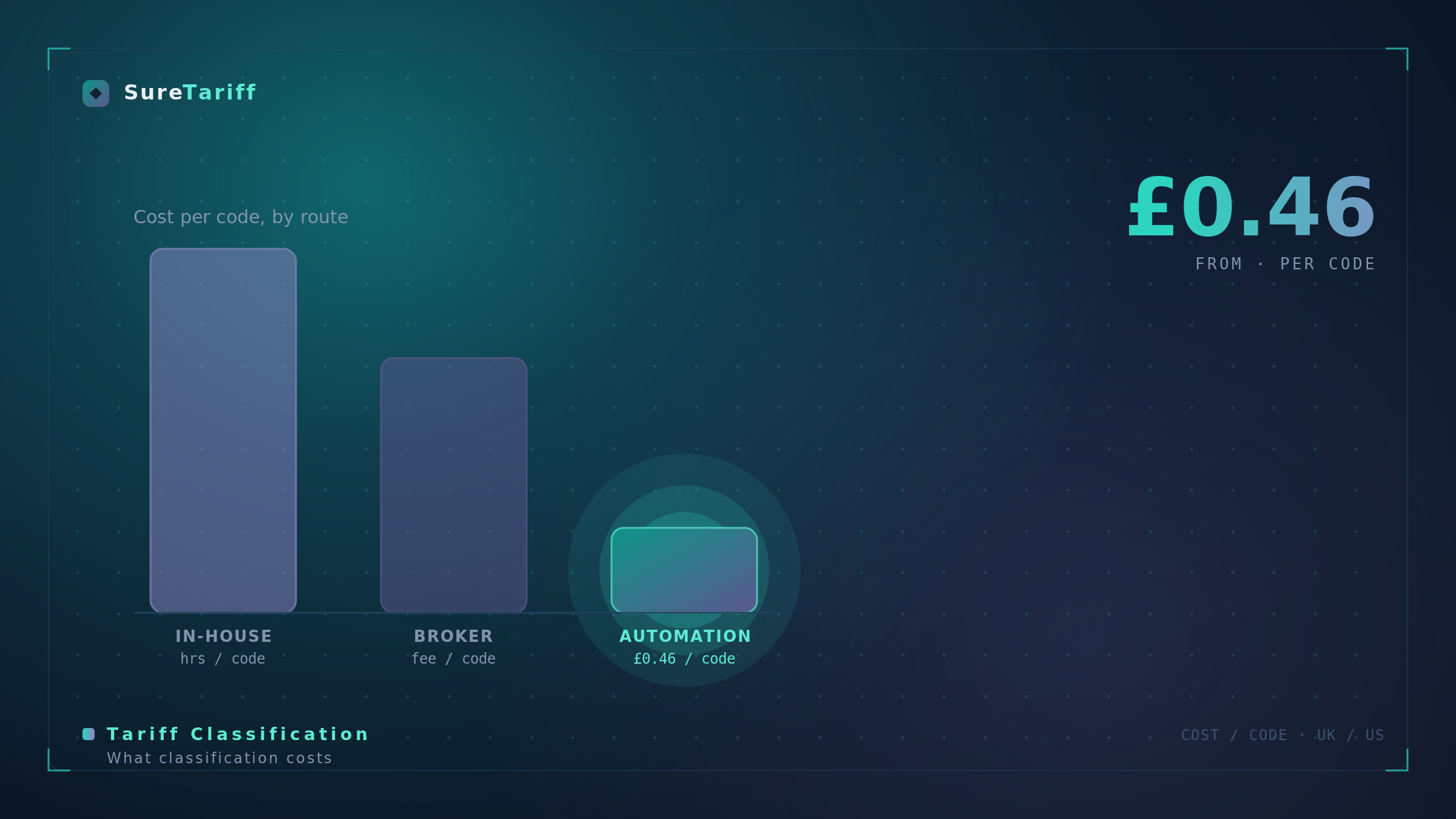
In-house classification uses your own people. Done properly it is skilled work: reading the product against the headings, the section and chapter notes and the interpretation rules. Senior trade-compliance time is not cheap, commonly costed in the region of 80 to 150 US dollars per hour once fully loaded, and a single genuinely complex product can absorb a meaningful part of an hour. Teams handling larger catalogues report spending anywhere from half an hour to an hour per item on the products that are not obvious. Multiply that across a few hundred new lines a season and the labour cost is substantial, before you count the opportunity cost of what those people were not doing instead.
Customs brokers and consultants move the work outside. This buys expertise, but it prices per code or per retainer, it is often opaque about how a code was reached, and it introduces a queue: you submit, you wait, you get a code back. For a handful of high-value or genuinely uncertain products that trade-off can be worth it. For a whole range refreshed several times a year, per-code fees add up fast and the waiting becomes a bottleneck in its own right.
Automation classifies from the product data you already hold, at a fraction of the per-code cost of either alternative. SureTariff prices from under 46 pence per code. At that level the calculation changes completely: classifying the entire range stops being a budget decision you ration and becomes a routine step you run whenever product data changes.
The costs that never reach an invoice
The visible cost of classification, staff hours or broker fees, is usually the smaller half. The larger half is the cost of getting it wrong, and it hides.
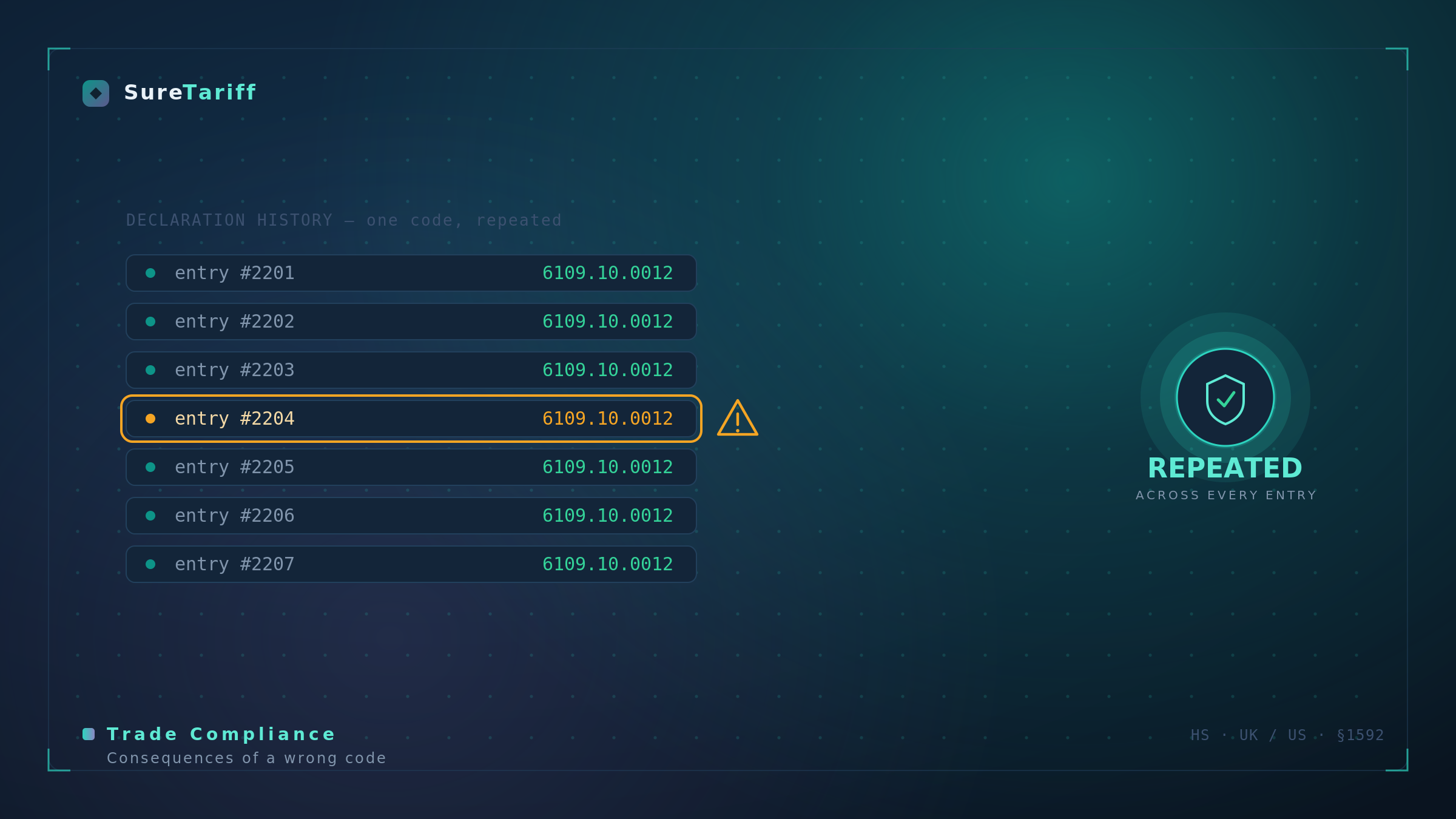
An over-cautious code, chosen to be safe, can mean paying more duty than the product actually attracts, on every shipment, indefinitely. An under-stated code means paying too little, which is not a saving but a liability: it becomes recoverable duty, interest and potentially a penalty when it is found. And because classification errors tend to sit undetected for months or years, the bill when it arrives is not one shipment's worth but every shipment since the error was made. A cheap classification that is wrong is the most expensive kind.
Then there is the queue itself. When classification is slow, product and buying teams wait on codes before they can finalise a landed cost, which delays pricing decisions and, at the extreme, delays getting product to market. That delay has a cost too, even though nobody invoices for it.
The volume problem
None of this bites for a business with ten stable products. It bites for a business with variety. A lifestyle brand does not have ten codes to sort, it has hundreds or thousands, spread across fabrics, materials, genders and constructions, and it does the whole exercise again every time it launches a collection, and again in full each time it opens a new market, since codes do not carry across. Fashion, footwear, bags, accessories and home ranges are all built on exactly this kind of proliferation.
For that business, per-item cost is everything, because the item count is large and recurring. A route that costs tens of pounds per code is affordable for a dozen products and unaffordable for a thousand. This is the specific reason automation earns its place in collection-heavy businesses: it removes the per-item cost as a constraint, so classifying everything, every season, becomes normal rather than exceptional.
Where automation changes the maths
The shift is not only that a code costs less. It is that a low, predictable per-code cost lets you classify comprehensively rather than selectively, and comprehensive classification is what actually reduces risk. When every product in a range is classified from its real data, at a cost low enough to ignore, three things follow: you stop rationing classification to the products someone remembered to check, you can re-run your history to catch old errors while they are still cheap to fix, and you get a landed cost for the whole range before you commit to pricing rather than after.
And because a good classification service returns each code with a confidence figure and the reasoning behind it, the low cost does not come at the expense of a defensible record. You are not buying cheap guesses, you are buying classifications you can stand behind, at a price that makes doing the whole range the obvious choice.
The cheapest classification, in the end, is the correct one done once, with the reasoning attached, at a per-code cost low enough that you never have to choose which products to skip.
Interested in learning more? Get in touch to discuss how we can help.
Join a demo